18 September 2026 — CCOP Presentation Brief
This presentation brief provides an overview of the Citizen Conference Of Parties (CCOP), the LUMEN diagnostic-action programme, and the current roadmap towards a methodological consensus for the UN post-2030 agenda.
It presents the rationale behind the initiative, the development of the LUMEN integrated governance infrastructure, the independent functional specification currently being prepared to stress-test LUMEN V0.1, and the experimental pathway planned for 2027–2028.
The brief also outlines the project’s approach to strong sustainability, value creation and preservation, Beyond GDP, open methodologies, and international experimentation.
Its objective is to make the CCOP’s current work, assumptions and next steps clear, transparent and open to discussion.
30 august 2026 — LUMEN France — Interactive Demonstrator
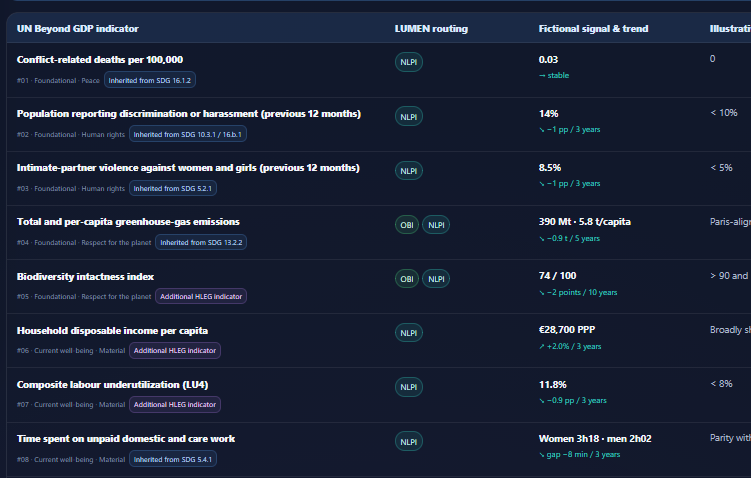
This interactive prototype illustrates how LUMEN could support public governance by connecting data, law, budgets, decisions, implementation and real-world outcomes within a single systemic architecture.
It also explores how UN Beyond GDP indicators could be integrated into an operational governance framework.
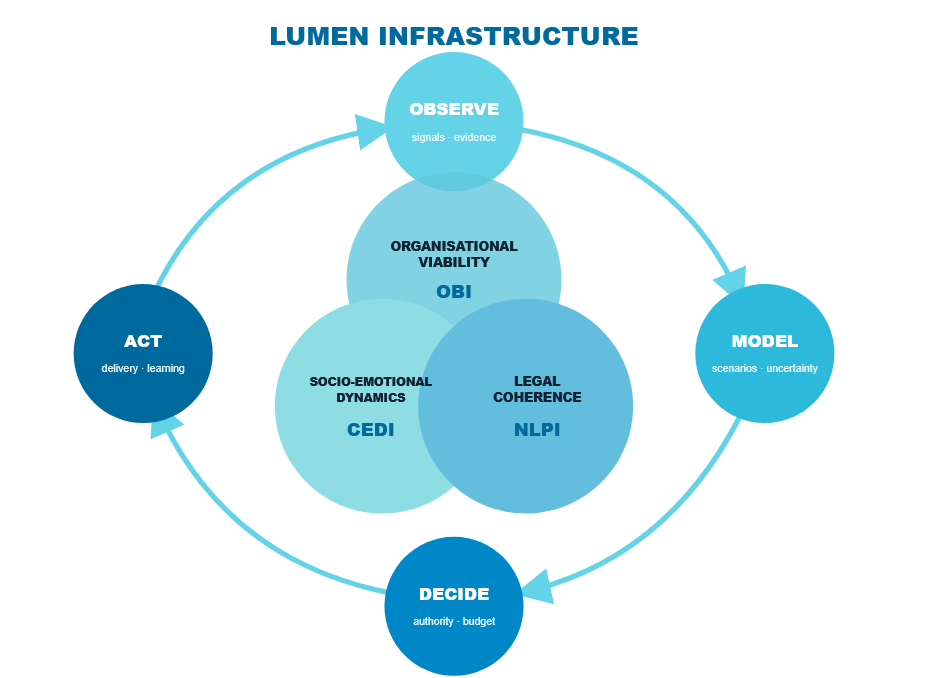
The core logic is continuous improvement:observe → model → decide → act → measure → learn → adjust
The demonstrator uses fictional data and is intended to make the LUMEN architecture tangible, testable and easier to discuss.
29 July 2026 — From multidimensional measurement to reflexive governance
The Citizen Conference Of Parties (CCOP) is pleased to present its contribution to the United Nations Beyond GDP process.
The contribution introduces LUMEN, a reflexive governance infrastructure designed to connect multidimensional evidence with observation, modelling, legitimate decision-making, action and continuous learning.
Ressources
Découvrez les ressources, outils et inspirations de la C.C.O.P.
Téléchargements
Tous les documents, outils et méthodologies sont en licence libre Creative Commons CC-BY-SA
➡️Gouverner dans la complexité, module pédagogique
Comment piloter un corps social en soutenabilités multiples dans l'Anthropocène ? (40 pages) PDF
➡️Premier patch systémique de gestion publique FRANCE (été 2026)
- Cadre d'engagement méthodologique de gouvernance exécutive
Note (FR, 4 pages) Pacte (FR, 7 pages) Guide (FR, 33 pages)
- Missions d'information parlementaires
Synthèse (FR, 20 pages) Note flash finances publiques (FR, 10 pages) Commissions des lois (FR, 60 pages)
Commission des finances (FR, 73 pages)
- Proposition de programme pilote national de redressement budgétaire par innovation méthodologique
Note transversale sur le Produit Légal Net (FR, 87 pages) Démonstrateur (FR)
- Propositions de lois pour l’amélioration de l'information électorale
Dossier Commun, version de travail (FR, 57 pages) PDF (FR) DOCX (FR)
➡️Qu'est ce que la valeur publique ? Note conceptuelle (été 2026, V1, PDF, 19 pages)
➡️Gouverner avec le vivant. Note de travail (été 2026, PDF, 17 pages)
➡️Dialogue inter programmes - Lumen X SPES (Sustainability, performance, evidences en scenarios, EU) (été 2026, PDF, 17 pages)
➡️Étude de cas, Orange ( été 2026, V1, PDF, 20 pages)
➡️La présentation de l'infrastructure de gestion LUMEN ( été 2026, V1, PDF, 19 pages)
➡️La cybernétique civilisationnelle (printemps 2026, V0.1, PDF, 7 pages)
FR EN
➡️Les fondements systémiques du programme LUMEN (printemps 2026, V0.1, PDF, 5 pages)
FR EN
➡️Le rapport synthétique d'activité 2022-2025 (printemps 2026, PDF, 2 pages)
FR EN
➡️Le résumé exécutif du programme LUMEN ( printemps 2026, V0.1, PDF, 4 pages)
FR EN
➡️La résolution 1 "United for good" (2022, PDF, 2 pages)
FR EN
➡️ Les statuts de la C.C.O.P. (V1, 2022, PDF, 10 pages)
FR EN